
Fields in Jefferson County Property Tax Records
These records span three offices and two main online systems. The Assessor inventories and values each parcel. The Auditor processes transfers, deductions, calculations, address changes, and copies. The Treasurer posts bills and annual history. It also collects payments and tracks delinquent amounts. Match the parcel and bill number before comparing figures across years.
| Field | What it reports | Custodian or system |
|---|---|---|
| Assessment | Value carried for the tax cycle | Assessor, WTHGIS, Treasurer history |
| Deduction | Amount reported apart from assessment | Auditor and Treasurer history |
| Gross tax | Tax before displayed credits | Treasurer detail |
| Credits | Unfunded and LIT credits in distinct columns | Treasurer detail |
| Delinquency or sale notice | Published parcel and statutory notice fields | Annual tax-sale PDF |
An assessed value is Indiana's market value-in-use figure for tax administration. It does not predict a sale price. Taxes on screen belong with their assessment and pay years, so keep the labels attached when comparing.
Jefferson County Treasurer Search Fields
The C009LIST search accepts a property or parcel number, a name, and a property address with city. A last name works best. Too much input can narrow the results, the page warns. A split or combination may have happened recently. In that case, a surname may surface several bills tied to one ownership trail.
| Control | Input | Result |
|---|---|---|
| Property/Parcel Number | State or local identifier | Potential exact bill match |
| Name | Start with surname | Owner and address rows |
| Property Address | Street and city | Address candidates |
| Tax-history detail | Open from a result | Year, assessment, deduction, credit, and tax columns |
Result rows also carry district, state parcel, tax-bill number, owner, and address. Because the page is marked "Not for Official Use!", confirm any consequential balance or status with the Treasurer.
Look Up a Jefferson County Property Tax Bill
Start in WTHGIS when only an address is known. Save the exact state parcel number and owner spelling. Then enter one strong field in the Treasurer search. The bill number in a matching result opens the annual detail.
- Find the parcel in WTHGIS and record its identifiers.
- Search C009LIST by parcel, surname, or address.
- Match the district, owner, and property address.
- Open history and keep assessment year separate from pay year.
- Ask the Treasurer for a current balance when the history does not establish one.
- Assessed value
- Market value-in-use used for Indiana tax administration.
- Deduction
- An amount administered separately from the assessment.
- Gross tax
- Tax shown before the listed credits.
- Tax lien
- A legal claim that can arise through unpaid taxes and statutory process.
Read Jefferson County Pay Years with Care
The Treasurer site displays annual rows running from 2015 through 2025. A 2025 row reads "2025 Pay 2026" and separates Assessment, Deduction, Gross Tax, Unfunded Cr, LIT Credits, and Taxes. Copy a number without its row label and the record can read wrong. The sample row shows an assessment of $223,100, a deduction of $118,040, gross tax of $3,246.46, an unfunded credit of $1,238.56, LIT credits of $0, and taxes of $2,007.90. Those figures illustrate the fields. They are not a current liability for any target parcel.
Pay Jefferson County Property Tax Through Official Channels
The Treasurer is in Room 105 at 300 E Main Street and uses PO Box 99, Madison, IN 47250 for mail. The office accepts cash and listed check types. The county also describes a drop box, bank payments with the statement, card payments with a 2.5% charge, and e-check payments with a $1 charge.
Published due dates are May 11 and November 10, subject to business-day or statutory adjustment. German American, Farmers, and Friendship are named bank locations. Cash must not go in the drop box, and the current amount should be confirmed before payment.
The Jefferson County Auditor Administers Deductions
The county lists age, blind, disability, disabled-veteran, and homestead deductions with the Auditor. That office also handles ownership transfers, tax calculations, and mailing-address changes. A bill owner can lag a recorded conveyance. So bring the parcel and street address when asking staff to reconcile a mismatch. The address-change form asks for property address, parcel, requested mailing name, phone, and full mailing address. It also requires a primary-residence answer, signature, and date. Failure to receive a statement does not remove payment responsibility, the form warns. Public copies run $0.25 per page as a planning figure.
Indiana's 2026 Cycle Reaches Jefferson County
A four-year cyclical reassessment begins July 1, 2026 for the 2026 Pay 2027 cycle. It touches about 25% of parcels each year. Annual adjustments still draw on sales and ratio-study concepts. The target is market value-in-use, not a copy of the last sale price. When county results are hard to locate, the state fallback exists. It is the DLGF assessed-value search.
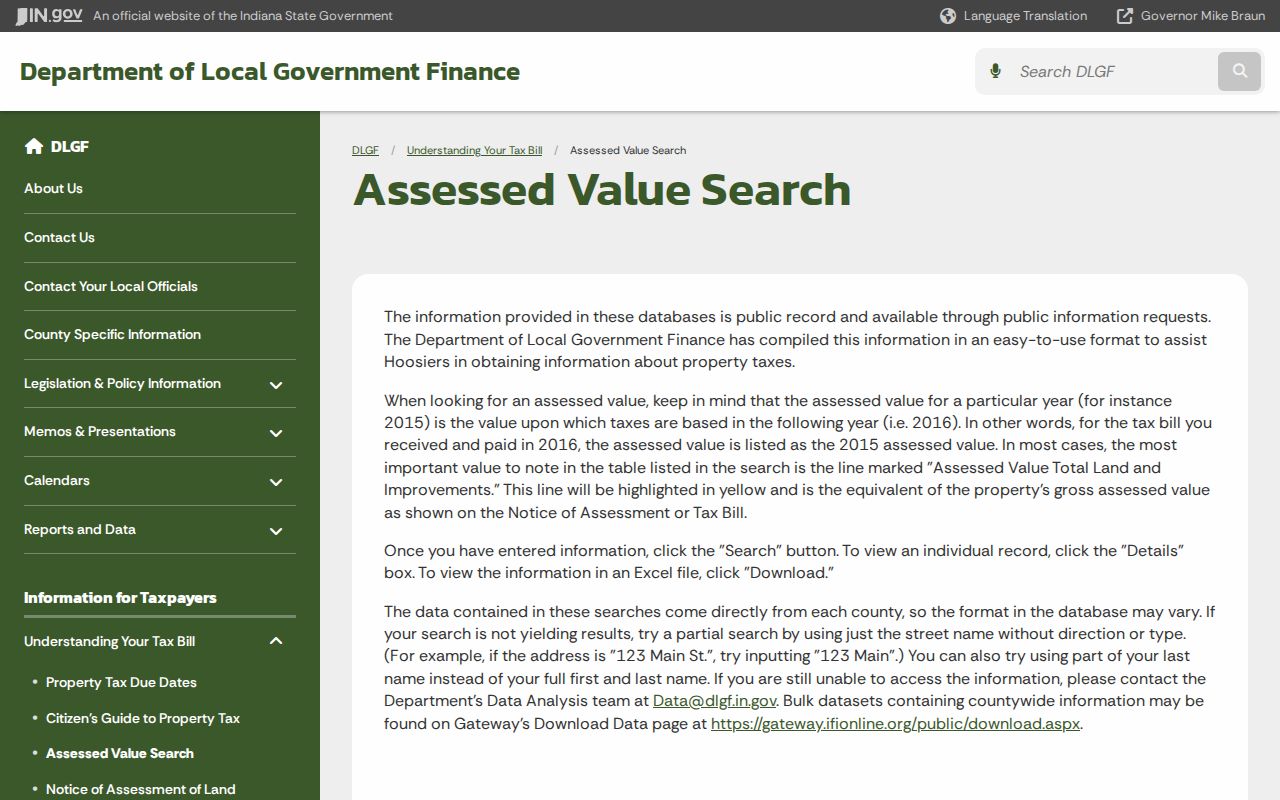
The state tool recommends partial street names without directions or types, plus partial last names. Jefferson County remains the source of the local data it displays.
Jefferson County Tax-Sale Notices Are Snapshots
Annual tax-sale notices exist for 2023, 2024, and 2025. Each can join state parcel, local parcel, owner, delinquency amount, legal description, acreage, deed reference, situs, and ZIP. A notice does not prove what happened after publication. Verify payment, redemption, sale, bankruptcy, and any later tax deed before calling land sold or available. The College Hills Lot 30 example links state parcel 39-14-13-200-003.000-002 with local parcel 009-00654-00 and a Hanover address. It illustrates the format, not a current status.
Contest a Jefferson County Property Assessment
Indiana appeals begin locally with Form 130. DLGF puts subjective value issues on page 1 and objective factual errors on page 2. Examples include the wrong person, a missing deduction, and a math error. Others are an incorrect description or a legality issue. Preserve the notice date. Follow current instructions. The route can run through an informal conference, PTABOA, and the Indiana Board of Tax Review. Tax Court sits at the end of that path. The county publishes no current 2026 PTABOA calendar. The Assessor or DLGF must confirm the live filing window.
Confirm the appeal window. Use the current notice date and ask which Form 130 deadline applies before filing.
Request Jefferson County Tax Records Offline
Offline requests still matter in Jefferson County, and a little planning makes them painless. The Treasurer sits in Room 105 of the courthouse. That office handles bills, payments, delinquency, credits, and current balances. The phone line at 812-265-8910 extension 1530 reaches the counter on weekdays. Have the tax-bill number handy. Bring state and local parcel IDs too. Bring the owner of record, the property address, and the tax years you need.
Two other rooms matter just as much. The Assessor in Room 102 explains property class, assessment year, and neighborhood. That office also covers routing number, acreage, land and improvement values, and the parcel card itself. The Auditor in Room 101 is the right custodian for ownership transfers, deduction history, and sales disclosures. That office also holds address changes, calculations, and public copies. Ask which office keeps a field before you pay anyone. That one question prevents duplicate requests.
A written public-record request works under Indiana's APRA, IC 5-14-3, which demands reasonable particularity. Mail a request and the seven-day response or acknowledgment rule generally applies. It is not a universal production deadline, though. An agency may cite a lawful exemption. It may instead point you to the office that actually holds the tax roll. It never has to build a fresh tax analysis from a vague question.
Build a Jefferson County Tax Evidence Packet
Good evidence starts with careful saving. Keep the source URL and the search date. Save the parcel number, bill number, selected year, and every column label. A screenshot only shows what appeared in a dynamic session. An official copy or office confirmation carries far stronger status. Preserve blank fields as blanks. Never assume they mean zero. Never treat a tax-sale notice as proof of a completed sale.
Match the packet to the dispute. An assessment question calls for the parcel card and the Form 11 notice. Add sale evidence, photographs or factual corrections, and current Form 130 instructions. A payment question needs the bill, the payment confirmation, and the Treasurer's balance response. A deduction issue? Keep the application, any approval or denial, and the tax year it touched.
This discipline also blocks a classic mistake. It stops you from treating assessed value, gross tax, or tax due as the property's market price. Each figure has a label and an administrative purpose of its own. Readers who want the value fields decoded can visit the property-value page. The focus here stays on the tax record and its official channels.